How to repair a damaged skin barrier (dermatology guide)
Yes, you can repair a damaged skin barrier. In most cases, especially after overusing exfoliating acids or retinoids, your skin recovers within 2 to 6 weeks once irritation is removed and hydration is restored.
A damaged barrier often shows up as burning, redness or sudden sensitivity after using strong skincare products. If your moisturiser suddenly stings or your skin feels tight, your barrier may be compromised.
Below, you’ll learn what is happening inside your skin and how to repair it safely.
Key takeaways
- A damaged barrier leads to increased transepidermal water loss (TEWL) and heightened skin reactivity.
- Overuse of exfoliating acids and retinoids is the most common reversible trigger.
- Immediate stabilisation, not more treatment, is the first step.
- Effective repair requires both hydration and controlled occlusion.
- Visible improvement may occur within weeks, but full barrier recovery takes consistency and time.
What is a damaged skin barrier?
The skin barrier is the outer protective layer of the skin that keeps moisture inside and blocks irritants from entering. It sits in the outermost part of the skin, called the stratum corneum.
You can compare it to a brick wall.
The skin cells are the bricks. The lipid matrix is the mortar that holds everything together.
When this structure is intact, your skin feels smooth and comfortable. When it is disrupted, gaps form between the cells and water escapes more easily.
This increased water loss is called transepidermal water loss, or TEWL.
The visual below helps show the difference between a healthy and a damaged skin barrier.
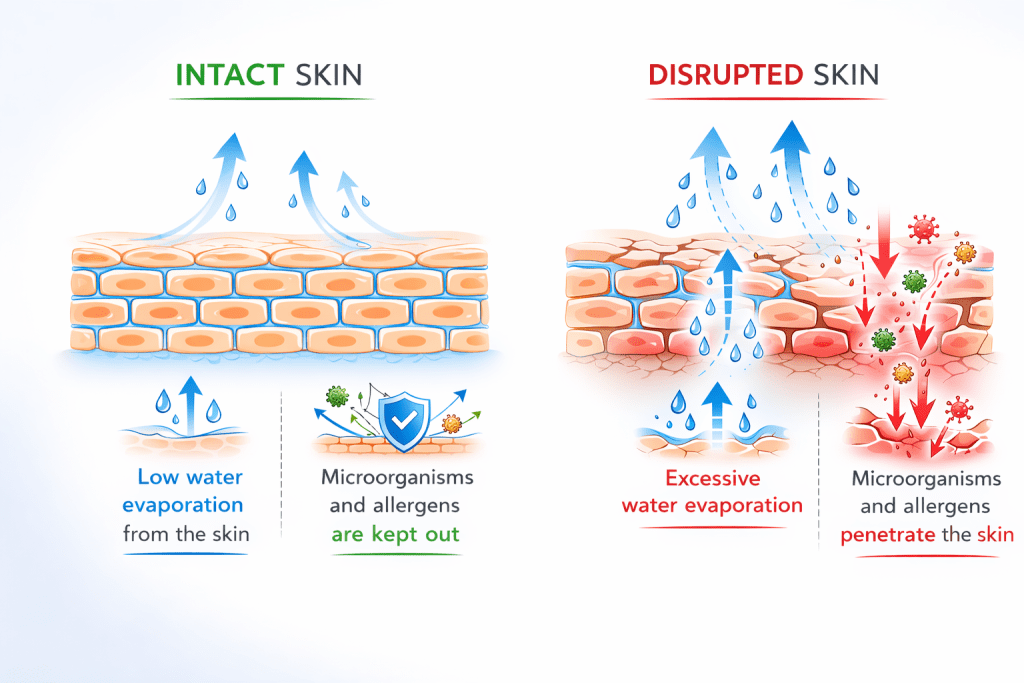
Higher TEWL means your skin dehydrates faster and becomes more reactive. Irritants penetrate more easily, which is why burning and redness often occur when the skin barrier is disrupted.
What causes a damaged skin barrier to break down?
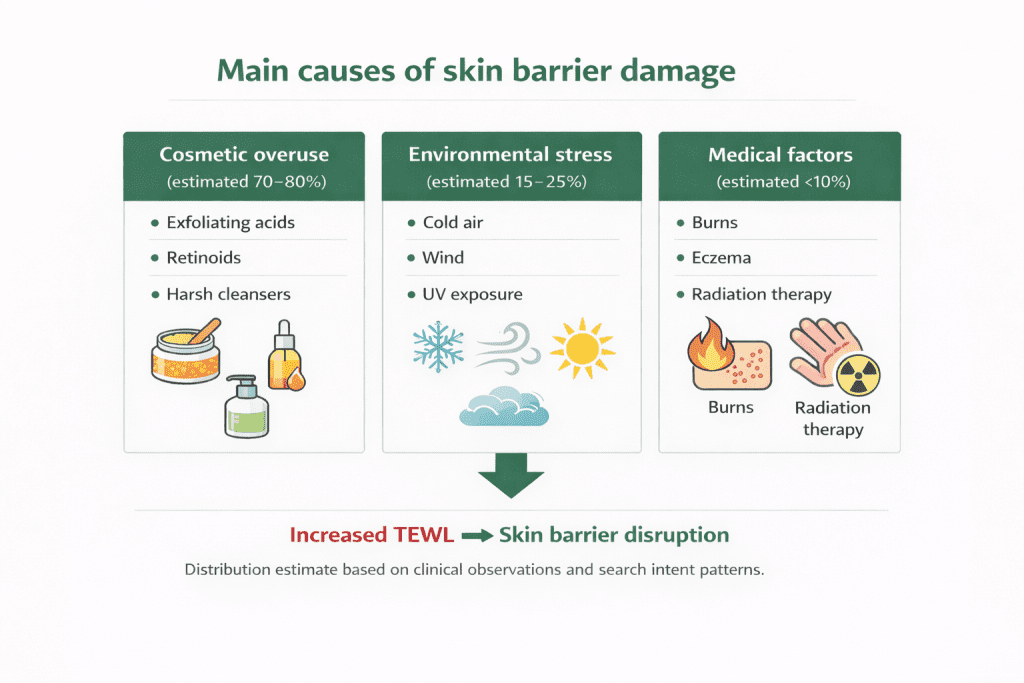
In most cases, the trigger is overuse of active ingredients.
Over-exfoliation
Using AHA or BHA (exfoliating acids) too frequently thins the outer layer of the skin. Daily exfoliation or combining multiple acids weakens the lipid structure.
Retinoid overuse
Retinol, tretinoin or adapalene increase cell turnover. When introduced too quickly or used too often, they impair barrier repair and increase TEWL.
Layering too many actives
Combining acids, retinoids and vitamin C within the same routine can place ongoing stress on the skin, reducing the time the barrier must repair itself between applications.
Environmental and medical factors
Cold weather, wind and UV exposure can weaken the barrier further.
Medical conditions such as eczema, burns or radiotherapy can also disrupt skin structure and increase TEWL.
For most readers, however, skincare overuse is the most common and reversible cause.
The visual below illustrates common causes of skin barrier damage. The percentages are illustrative estimates based on clinical experience, not epidemiological studies.
What are the symptoms of a damaged skin barrier?
When the skin barrier is compromised, the skin becomes more reactive and loses moisture more easily. Common symptoms include:
- Burning sensation when applying products
- Redness
- Dryness and flaking
- Tightness after cleansing
- Sudden sensitivity to products that previously did not cause irritation
Step-by-step plan to repair your skin barrier
Repairing a damaged skin barrier does not begin with adding more products. It begins with doing less.
Step 1: Stop active ingredients
If your barrier is compromised, temporarily stop using:
- AHA and BHA (exfoliating acids)
- Retinoids such as retinol, tretinoin or adapalene
- Vitamin C, especially low-pH formulas
The first goal is stabilisation, not exfoliation.
Removing actives allows lipid production to recover and TEWL to gradually decrease.
Step 2: Simplify your routine
Once you have paused active ingredients, the next step is to simplify everything else. Fewer products mean fewer potential irritants.
In the morning:
- Start with a gentle cleanser: Use a mild, fragrance-free cleanser that does not leave your skin feeling tight. Avoid strong foaming formulas.
- Follow with a barrier-supporting moisturiser: Choose a gentle formulation that helps reduce TEWL and support lipid recovery. The key characteristics are explained in Step 3.
- Finish with daily SPF: Apply a broad-spectrum sunscreen as the final step of your morning routine.
In the evening:
- Gentle cleanse: Remove sunscreen and impurities without stripping the skin.
- Moisturiser: Apply a generous layer to support overnight barrier repair.
Step 3: Choose the right moisturiser
In step 2, we reduced your routine to one moisturiser. Now let’s define what makes it effective for barrier repair.
When your skin barrier is damaged, hydration alone is not enough. You need a formulation that restores water balance and reduces transepidermal water loss (TEWL) at the same time.
An effective barrier-supporting moisturiser combines three functional ingredient groups.
Humectants
These attract and bind water in the stratum corneum. Examples include glycerine, hyaluronic acid and aloe vera. They increase surface hydration, but without protection, that water can evaporate again.
Emollients
These soften the skin and help fill small lipid gaps between skin cells. Fatty acids, plant oils and lipid-like ingredients support the skin’s flexibility and improve barrier integrity.
Occlusives
These create a protective layer on the surface to reduce TEWL. Ingredients such as petrolatum or dimethicone limit water evaporation while the barrier repairs itself.
A balanced combination of humectants, emollients and mild occlusives creates the right environment for repair.
A moisturiser that supports barrier repair
An effective barrier-repair moisturiser combines the three functional ingredient groups discussed above. Together, these functions create the conditions the skin needs to rebuild its barrier.
Semi-occlusive formulations help maintain hydration while limiting transepidermal water loss without fully sealing the skin. For example, ALHYDRAN uses aloe vera as a humectant base, combined with skin-supporting emollients and a semi-occlusive structure that helps reduce water loss.
The formulation is supported by clinical and in vivo research demonstrating effects on skin hydration and skin barrier function in several skin conditions.
In situations where the skin barrier is more severely compromised, additional soothing support may be beneficial, for example after chemical peels, laser procedures or other intensive cosmetic treatments.
For these situations, ALHYDRAN Barrier Repair Care has been specifically developed for temporarily compromised skin.
This variant is enriched with:
- Beta-glucan, known to help reduce redness and calm reactive skin
- Bisabolol, which soothes irritation
- Allantoin, which supports skin recovery
- Glycerin, a humectant that enhances hydration
Barrier Repair Care is designed to improve recovery comfort after professional treatments, when the skin is more sensitive, prone to increased TEWL and temporarily more vulnerable to irritation.
It can be used during post-procedure care or as a booster applied in a thin layer under a day or night cream.
Repair your skin barrier with ALHYDRAN Barrier Repair
Step 4: Protect from UV
UV radiation increases inflammation and slows barrier recovery. When the skin barrier is compromised, exposure to UV light can further elevate transepidermal water loss (TEWL) and delay the restoration of the lipid matrix. Even if your skin feels calmer, it is still physiologically vulnerable during the repair phase. Therefore, daily broad-spectrum sun protection helps prevent additional damage and supports structural recovery of the stratum corneum. You can read more about selecting the right formula in our blog on sun cream for sensitive skin.
Step 5: Be patient
Repairing a damaged skin barrier usually takes 2 to 6 weeks, depending on the severity of the disruption. Even if redness and burning improve quickly, the underlying lipid matrix needs weeks to fully recover.
- Light damage improves within 2 to 3 weeks
- Moderate damage may take 4 to 6 weeks
However, transepidermal water loss (TEWL) can remain elevated for several weeks after visible symptoms decrease. This means your skin may look better before the barrier is fully stabilised.
During this phase:
- Do not reintroduce active ingredients too early
- Add actives back one at a time
- Start with low frequency
Barrier repair is not about speed. It is about consistency.
When should you see a doctor?
You should seek medical advice if you notice signs that go beyond typical dryness, tightness, or mild sensitivity.
Contact a doctor if you experience:
- Severe or persistent pain in the affected skin area, especially if it worsens instead of improving
- Oozing fluid, yellow discharge, or crusting, which may indicate infection
- Widespread redness, swelling, or inflammation that extends beyond the original irritated area
- Symptoms that do not improve after 4 to 6 weeks, despite simplifying your skincare routine
You should also seek medical care if the damaged skin barrier is linked to an underlying condition, such as eczema, rosacea, or a recent medical treatment like chemical peels, laser therapy, radiation, or surgery. In these cases, structured medical treatment and prescription products may be necessary to properly restore the skin barrier and prevent complications.
Conclusion
A damaged skin barrier can feel alarming, but in most cases caused by skincare overuse, it is fully reversible. Recovery starts by removing irritation, simplifying your routine and restoring hydration while reducing transepidermal water loss (TEWL). A balanced moisturiser that combines humectants, emollients and mild occlusives creates the right environment for repair. Redness may improve quickly, but full lipid recovery takes time. With patience and gentle care, your skin barrier can rebuild and return to a stable, resilient state.
FAQ
Can a damaged skin barrier heal itself?
In most cases caused by skincare overuse, yes. The skin barrier is a dynamic structure that continuously renews itself. The outer layer of the skin, the stratum corneum, regenerates through ongoing cell turnover and lipid production. When irritating products such as exfoliating acids or retinoids are removed, inflammation gradually decreases and lipid synthesis can resume. As the lipid matrix rebuilds, transepidermal water loss (TEWL) decreases and hydration stabilises.
Is my skin permanently damaged?
Almost never when the damage is caused by cosmetic overuse. Skincare-induced barrier disruption is typically functional, not structural. That means the outer layer is temporarily weakened, but the deeper layers of the skin remain intact. In most cases involving over-exfoliation or retinoid irritation, the skin fully recovers once the routine is simplified and irritation stops. This is very different from true scarring or chronic inflammatory skin disease.
Can I wear makeup while repairing my barrier?
You can, but only if it does not sting or worsen irritation. When the barrier is compromised, the skin becomes more reactive. Fragrance, alcohol, or long-wear formulas can increase discomfort. If makeup causes burning or tightness, it is better to pause it temporarily.
If you choose to wear makeup:
- Use minimal products
- Avoid heavy mattifying or drying formulas
- Remove it gently without aggressive cleansing
Does hyaluronic acid fix the skin barrier?
No, not on its own. Hyaluronic acid is a humectant. It attracts and binds water in the stratum corneum, increasing surface hydration. However, it does not directly repair the lipid matrix and does not significantly reduce TEWL without occlusive support.
For effective barrier repair, hydration must be combined with ingredients that:
- Replenish lipids (such as ceramides or fatty acids)
- Provide mild occlusion to prevent water loss
Hyaluronic acid can be helpful as part of a balanced formulation, but it is not a standalone barrier-repair solution.
Should I slug with petroleum jelly?
Slugging means applying a thick layer of petrolatum (Vaseline) over your moisturiser to create strong occlusion and minimise water loss. Petrolatum is one of the most effective ingredients for reducing TEWL. In cases of severe dryness or acute barrier disruption, short-term use can help stabilise hydration. However, slugging is not ideal for everyone. It may:
- Feel heavy or uncomfortable
- Increase breakouts in acne-prone skin
- Trap heat and sweat
In most cases of cosmetic barrier damage, a balanced moisturiser with moderate occlusion is sufficient. Complete occlusion is rarely necessary long term.
Should you do “skin fasting”?
Skin fasting means stopping all skincare products to allow the skin to “reset”. While it is essential to pause irritating active ingredients such as acids or retinoids, stopping moisturiser altogether is not recommended when the barrier is compromised. When transepidermal water loss (TEWL) is elevated, the skin loses moisture more easily. Without a supportive moisturiser to reduce water loss and reinforce the lipid layer, dehydration can worsen and prolong tightness, sensitivity and irritation. Barrier repair requires controlled support, not withdrawal of all products. The correct approach is to remove irritants, simplify your routine and continue using a barrier-supporting moisturiser while the skin rebuilds.
References:
- Hoeksema, H., Van de Sijpe, K., Tondu, T., Hamdi, M., Van Landuyt, K., Blondeel, P., & Monstrey, S. (2013). A new, occlusive, topical gel‐based therapy for the treatment of hypertrophic scars: A prospective, controlled clinical study. Burns, 39(7), 1433–1438. https://doi.org/10.1016/j.burns.2013.02.018
- Proksch, E., Brandner, J. M., & Jensen, J. M. (2008). The skin: An indispensable barrier. Experimental Dermatology, 17(12), 1063–1072. https://doi.org/10.1111/j.1600-0625.2008.00786.x